Showing posts sorted by date for query dome budohi. Sort by relevance Show all posts

Wednesday, 14 February 2018

Dedan Kimathi
''Minong’ono ilikuwa ikisikika kutoka kanda ya ziwa kuwa kiongozi wa wapiganaji wa Mau Mau, Dedan Kimathi alikuwa anaonekana mjini Mwanza. Wakati ule pale Mwanza kulikuwa na Wakikuyu wengi wakifanya biashara sokoni. Ilivumishwa kuwa Dedan Kimathi alikuwa akiwasiliana na Wakikuyu wenzake na wao walikuwa wakimkusanyia fremu za baiskeli za zamani ili zitumike kutengenezea magobole ili zitumiwe misituni dhidi ya majeshi ya Waingereza. 

Mapigano yalipoonza kati ya Mau Mau na Waingereza kulikuwa na Wakikuyu kama elfu kumi na sita wakiishi na kufanya kazi kaskazini ya Tanganyika. Kama tahadhari, Wakikuyu wachache walioonekana kuunga mkono Mau Mau, walikamatwa na kupelekwa Kenya ambako waliwekwa kizuizini katika kambi mbali mbali. Wakati Budohi na Wakenya wengine walipopita Korogwe wakati wakirudishwa Kenya kupitia Taveta, Ally Sykes, ambaye alikuwa amehamishiwa Korogwe, alikwenda hadi stesheni ya reli kuwaaga. Watuhumiwa hawa wa Mau Mau walikuwa wametiwa katika mabehewa ya kubebea ng'ombe huku wamefungwa minyororo. Dome Budohi na wazalendo wengine waliwekwa kizuizini kwa miaka saba. 

Dome Okochi Budohi TANU kadi no. 6

Kulikuwepo na wazalendo kutoka nchi jirani ya Kenya kama vile Dome Okochi Budohi na Patrick Aoko ambao walikuwa wanajua vyema siasa za walowezi za kupora ardhi za  wananchi. Kutoka kwa wazalendo kama hawa, Abdulwahid alipata usikivu wa mawazo yake ya kuigeuza TAA kuwa chama cha siasa chenye nguvu. Lakini mara tu baada ya kuundwa kwa TANU wazalendo hawa wa Kenya wakakamatwa na serikali. Kwa miezi sita walihojiwa na kuwekwa rumande Central Police Station huku wamefungwa minyororo. Budohi na Aoko walikuwa wakifuatwa na makachero (Special Branch) toka mwaka wa 1952 baada ya hali ya hatari kutangazwa Kenya. Inasemekana Dome Budohi aliponzwa na barua iliyotoka Kenya ambayo ilikamatwa na makachero. Barua hii ilikuwa inamuhusisha Budohi na Mau Mau. Inasemekana Budohi alisalitiwa na Mkenya mwenzake aliyeitwa Martin ambaye alikuwa pamoja naye katika Blackbirds. Martin alikuwa akipuliza tarumbeta.

Askari waliokuwa wakiwalinda kule rumande walitoa habari kwa TANU kuwa kulikuwa na mpango wa kuwapa sumu wafungwa wale, Budohi na mwenzake Aoko. Baadaye wafungwa hawa walihamishiwa Handeni ambako kulikuwa na kambi ya kuwafunga watuhumiwa wa Mau Mau. Kawawa alikuwa amehamishiwa hapo kutoka Dar es Salaam. Baadhi ya wafungwa walikuwa wananachama wa TAA na baada ya kuundwa TANU wakawa wanachama wa TANU. Kawawa alikuwa akifahamiana na wengi kati ya wafungwa wale. Budohi na Aoko waliwahi kuwa  viongozi wa TAA. Kawawa aliwaangalia wafungwa hawa kwa moyo wa huruma akijaribu kupunguza shida zao pale kambini kila alipopata mwanya wa kufanya hivyo.''


***


''Mara tu baada ya kuundwa kwa chama cha TANU Wakenya walikamatwa na kurudishwa Kenya ambako waliwekwa kizuizini Manyani na katika kisiwa cha Lamu. Wazalendo wa Kenya waliokuwa katika harakati nchini Tanganyika hawakuwa na uhusiano na TANU baada ya uhuru na wala chama hakikufanya juhudi kuwasiliana nao. Dome Budohi alijaribu mara nyingi kuomba kukutana na Nyerere alipozuru Nairobi lakini ilishindikana. Budohi hafahamu kama maafisa wa serikali ya Tanzania walimzuia wao tu au walifanya hivyo kwa amri ya Nyerere. Hadi anafariki Dome Budohi hakuwahi kuonana na Nyerere ambae wakati wa enzi za TAA na TANU walikuwa wakifahamiana vizuri.''
(Kutoka kitabu cha Abdul Sykes)


Tuesday, 6 February 2018

Uhuru, Jumanne Februari 6, 2018
ALLY KLEIST SYKES
Mpigania uhuru aliyempokea Nyerere Dar es Salaam
L Alimkabidhi kadi namba moja ya TANU
L Mwandishi wa karatasi zilizowakera Wakoloni
NA MUSSA YUSUPH
UHURU wa Tanganyika haukuwa kazi rahisi kupatikana kama ambavyo wengi wanadhania.
Ili kuwa ni shughuli pevu iliyohitaji kujitoa kwa hali na mali ili kuhakikisha Waafrika kutoka Tanganyika ambalo lilikuwa koloni la Uingereza, wanajitawala.
Jitihada hizo zilifanywa na wapigania uhuru mbalimbali waliounganishwa kupitia chama cha Tanganyika National Unioni (TANU), kilichoundwa na na watu waliojawa na shauku la kujitoa kwenye makucha ya kikoloni.
Ally Kleist Sykes mzaliwa wa Mtaa wa Gerezani, Kariakoo Dar es Salaam, ni miongoni mwa waasisi waliopigania uhuru wa Tanganyika ambaye ana mengi ya kukumbukwa.
Mzee huyo aliyezaliwa Oktoba 10 mwaka 1926 kisha kufariki Dunia Mei 19 mwaka 2013 alikuwa mzalendo aliyeanza harakati za kisiasa kwenye miaka ya 1950.
Ally Sykes ndiye aliyemwandikia na kumkabidhi Hayati Mwalimu Julius Nyerere kadi ya TANU namba moja.
Pia alikuwa miongoni mwa waasisi wa TANU, kati ya wazee watu saba waliokuwa katika kamati ya TAA iliyounda TANU.
Alikuwa miongoni mwa wafadhili wakuu wa TANU, huku akiwa tegemeo la chama hicho katika kutekeleza mikakati hatari dhidi ya utawala wa Uingereza.
Katika siasa za sasa Mzee Ally Sykes anaweza akaelezewa kama "Mzee wa fitna" kwani alikuwa majukumu ya kuwagombanisha wananchi dhidi ya serikali ya kikoloni.
Majukumu hayo aliyatelekeza kwa kuchapa karatasi ambayo Waingereza waliyaita ya kuchochea ghasia kwani majasusi wa serikali ya kikoloni walimfahamu kwa uhodari wa kutengeneza mambo.
Waingereza walipata wakati mgumu kumkabili kwani licha ya uhodari wa kisiasa aliokuwa nao, Ally Sykes pia alikuwa na medali ya mlenga shabaha mahiri, aliyopata kwenye Vita Kuu vya Pili ya Dunia.
Kwenye vita hiyo Ally Sykes alikuwa kwenye bataliani ya sita (Battalion 6 Burma Infantry) King's African Rifles (KAR) 
Hakika Ally Sykes alikuwa mzalendo, mweledi wa mambo na miongoni mwa waasisi muhimu wa TANU ambaye sahihi yake ndio iko katika kadi ya TANU ya Mwalimu Nyerere.
Umaarufu wake ni kama aliurithi kutoka kwa Baba yake Mzee Kleist Sykes aliyekuwa watu mashuhuri  Dar es Salaam katika miaka ya 1900 hadi alipofariki mwaka 1949.
Baba yake alikuwa maarufu kwa kuwa alilelewa na Affande Plantan aliyekuwa askari kiongozi katika jeshi la Wajerumani lilokuja Tanganyika na Herman Von Wissman.
Kleist alikuwa ndiye katibu muasisi wa African Association mwaka 1929 chama kilichokuja baadae kujibadili na kuwa TANU ambacho Ally Sykes akiwa mmoja wa waasisi.
Pia baba yake aliasisi Al Jamiatul Islamiyya Fi Tanganyika (Umoja wa Waislam wa Tanganyika) na kupitia jumuia hiyo akajenga shule ya kwanza ya Kiiislam Dar es Salaam, ambayo ilisomesha Qur’an pamoja na elimu ya kimagharibi.
Jumuiya hiyo ilichangia vijana wengi wa kiislamu kuingia kwenye siasa za TAA na TANU katika harakati za kudai uhuru.
AKUTANA NA NYERERE
Ally Sykes na kaka yake Abdulwahid Sykes ndio watu wa mwanzo kumpokea Mwalimu Nyerere alipokuja Dar es Salaam mwaka 1952.
Nyerere alifika nyumbani kwa akina Sykes na ilijenga urafiki ambao ulipitiliza na kuwa udugu mkubwa wa mapenzi ya dhati si baina yao tu bali hata kwa wake na mama zao.
Mama yake Nyerere, Bi. Mugaya mara kwa mara alipenda kumtembelea nyumbani Bi Mruguru biti Mussa ambaye ndiye mama wa Sykes.
Pia Mama Maria Nyerere alikuwa mwenye urafiki wa karibu na Bi. Zainab ambaye ni mke wa Ally Sykes aliyekuwa akiishi Mtaa wa Kipata.
Wakati huo harakati za kuanzisha TANU zilikuwa zimepamba moto huku fitna za Waingereza kuwatokomeza viongozi shupavu wa TAA kama Hamza Mwapachu, Dk. Vedast Kyaruzi, Dk. Wilbard Mwanjisi, zilikivunja nguvu chama hicho.
Ndio maana TANU ilipokuja kuasisiwa mwaka 1954 Ally Sykes kadi yake ya TANU ikawa namba mbili, Nyerere namba moja, Abdulwahid Sykes kadi yake namba tatu, Dossa Aziz kadi namba nne na John Rupia kadi yake ilikuwa namba saba.
Kipindi hicho Ally Sykes alikuwa Katibu wa Tanganyika African Government Servants Association (TAGSA) na vilevile alikuwa mwakilishi wa chama hicho katika Kamati ya Uajiri ya Serikali (Government Establishment Committee).
Thomas Marealle ndiye alikuwa rais wa TAGSA na Rashid Kawawa alikuwa mwanakamati.
Wanasiasa hao walijipa jina la ‘’Wednesday Tea Club’’ wakikutana kila siku ya Jumatano kunywa chai pamoja na kupanga mikakati ya kuwang’oa Waingereza katika ardhi ya Tanganyika.
Kupitia Ally, Abdulwahid na Dossa Aziz, Nyerere aliweza kujuana na wenyeji wa Dar es Salaam maarufu baadhi yao ni Sheikh Hassan bin Amir, Mshume Kiyate, Jumbe Tambaza, Sheikh Suleiman Takadir, Clement Mtamila, Titi Mohamed na Tatu biti Mzee.
NYARAKA ZA HISTORIA YAKE
Baadhi ya nyaraka za historia alizozitunza nyumbani pake na kumpatia Mohamed Said, mpaka Ally Sykes, anafariki dunia zinadaiwa bado zilikuwa kwenye mikono ya Mohamed Said.
Ally Sykes aliwahi kumlalamikia kuwa nyaraka hizo ni mali ya taifa na lazima azikabidhi serikalini kwa kuhifadhiwa na kuwekwa kama urithi wa kizazi kijacho.
Inadaiwa kuwa nyaraka za Ally Sykes zinakwenda zimeelezea historia tangu babu yake Sykes Mbuwane alipoingia Tanganyika kutoka meli ya kivitia ya Wajerumani iliyotia nanga Pangani akitokea Msumbiji.
Nyaraka hizo zinadaiwa kuwa na barua za wanasiasa wa mwanzo katika Tanganyika mbali historia ya baba yake.
Inasemekama zimeelezea habari kuhusu wazalendo na machifu, wanasiasa wenye asili ya Kiasia na Waingereza wenyewe waliokuwa watawala.
Ally Sykes ameelezea harakati za Dk Joseph Mutahangarwa, Chifu Abdieli Shangali wa Machame, Paramount Chief Thomas Marealle wa Marangu, Chifu Adam Sapi Mkwawa wa Wahehe, Chifu Harun Msabila Lugusha na Dk. Wilbard Mwanjisi.
Wengine ni Abdulkarim Karimjee, Dk. Vedas Kyaruzi, Liwali Juma Mwindadi, H.K. Viran, Stephen Mhando, Dossa Aziz, Ivor Bayldon, Yustino Mponda, Ivor Bayldon, Rashid Mfaume Kawawa, Bhoke Munanka, Rashid Kheri Baghdelleh na  Robert Makange.
Wanasiasa wengine aliowaelezea ni Saadani Abdu Kandoro, Malkia Elizabeth, Chief Secretary Bruce Hutt, Gavana Edward Twining, Gavana Ronald Cameron, Mwalimu Thomas Plantan na ndugu zake Schneider Abdillah Plantan na Ramadhani Plantan.
Pia wapo wakina Mwalimu Mdachi Shariff, Mwalimu Nicodemus Ubwe, Kassela Bantu, John Rupia, Hamza Kibwana Mwapachu, Othman Chande, Leonard Bakuname, Stephen Mhando, Oscar Kambona, Peter Colmore, Albert Rothschild, Ali Mwinyi Tambwe, Alexander Thobias, Japhet Kirilo, Joseph Kimalando, Ian Smith, Roy Welensky, Jim Bailey na Kenneth Kaunda.
Ally Sykes kwenye nyaraka hizo zinadaiwa amewaelezea wakina, Meida Springer, John Hatch, Gretton Bailey, Brig. Scupham, Dome Okochi Budohi, Annur Kassum, Nesmo Eliufoo, Yusuf Olotu, Joseph Kimalando na Mwalimu Julius Nyerere kwa nyadhifa walizokuja kuzishika kwenye Tanganyika huru.
xxxx

Friday, 8 December 2017


Baba wa Taifa Mwalimu Julius Kambarage Nyerere
(1922 - 1999)

MASHUJAA WALIONYANYUA SILAHA

Bushiri Bin Harith

Sultani Abdulrauf Songea Mbano
Shujaa wa Maji Maji
Selemani Mamba
Shujaa wa Maji Maji


MISINGI YA UTAIFA ILIYOWEKWA NA AFRICAN ASSOCIATION 
1929 - 1954

Kushoto aliyesimama ni Ally Kleist Sykes, na kulia kwake ni
Abdulwahid Kleist Sykes, mbele kushoto ni Kleist Sykes 
Mbuwane na Abbas Kleist Sykes. Katika hawa aliye hai ni Abbas
Ukoo huu umeacha kumbukumbu nyingi kwa maandishi katika harakati za
kuunda African Association 1929 na kuunda TANU 1954. Picha hii imepigwa
mwaka wa 1942 Abdul aliporudi Dar es Salaam kutoka Lower Kabete Kenya
alipokuwa akipata mafunzo ya kijeshi katika King's African Rifles kabla
hajakwenda Burma kujiunga na Burma Infantry. Angalia utaona Abdul amevaa 
sare ya Jeshi la Mfalme wa Uingereza. Ilikuwa akiwa Burma Vita Vya Pili Vya Dunia
(1938 - 1945) ndipo alipoamua kuwa 6th Battalion iliyokuwa na askari kutoka 
Tanganyika waunde TANU wakirudi Tanganyika kudai uhuru.


WAZALENDO WAPIGANIA UHURU KATIKA TANU
1954 - 1961

Waasisi wa TANU 7 Julai 1954

Baraza la Wazee wa TANU

Photo: Resignation Letter JKN
Barua ya kujiuzulu kazi ya Mwalimu Julius Nyerere, 1955

Hamza Kibwana Mwapachu
(1913 - 1962)
Abdul Sykes
(1924 - 1968)

Kushoto: Dossa Aziz, Julius Nyerere, Abdulwahid Sykes na Lawi Sijaona
katika dhifa ya kumuaga Nyerere safari ya pili UNO 1957

Kushoto: Bi. Chiku bint Said Kisusa, wa tatu Julius Kambaraga Nyerere wa tano Bi. Titi Mohamed na Bi. Tatu bint Mzee wanamsindikiza Mwalimu Nyerere Uwanja wa Ndege safari ya UNO 1955

Kulia: Bi. Titi Mohamed, Clement Mohamed Mtamila, Sheikh Suleiman Takadir, Julius Nyerere
Nyuma kulia: John Rupia, Rajab Diwani na Mama Maria Nyerere

UPINZANI WA SHEIKH HUSSEIN JUMA (UTP) 1956 
NA
 ZUBERI MTEMVU (ANC) 1958

Sheikh Hussein Juma
Vice President United Tanganyika Party (UTP)

Zuberi Mtemvu
President African National Congress (ANC)


MIKUTANO YA TANU MNAZI MMOJA NA JANGWANI 1954/55


Mwalimu Julius Nyerere na Bi. Titi Mohamed katika mkutano wa hadhara Viwanja Vya Jangwani

Idd Faiz Mafungo (Mweka Hazina wa TANU na Al Jamiatul Islamiyya) Mratibu wa safari ya Baba wa Taifa UNO 1955,
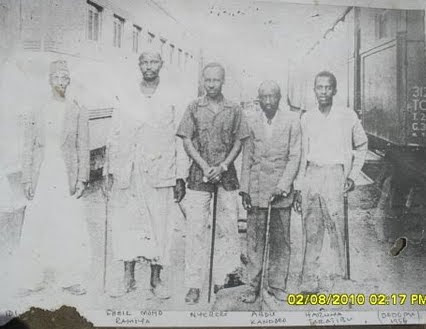
Sheikh Mohamed Ramiyya wa Bagamoyo, Julius Kambarage Nyerere, Abdu Kandoro na Haruna Taratibu Dodoma 1956

BANTU GROUP WAHAMASISHAJI NA WALINZI WA VIONGOZI 1955


Kulia: Zuberi Mtemvu, Julius Nyerere na John Rupia waki wa na Bantu Group


Robert Makange mwandishi wa gazeti la Mwafrika

KUMBUKUMBU YA MIAKA 20 YA TANU 1974


KUMBUKUMBU YA MIAKA 50 YA UHURU 2011

Ofisi Ndogo ya CCM Sherehe ya Miaka 50 ya Uhuru 9 December, 2011

Jengo Jipya la CCM Lumumba Avenue Dar es Salaam

UHURU 1961

Mwalimu Nyerere na Bi. Titi Mohamed

Kulia: Sheikh Issa Nasir, Oscar Kambona, Bi. Mugaya Nyang'ombe kulia kwa Mwalimu Nyerere Rajab Diwani
Karimjee Hall


Baraza la Kwanza la Mawaziri 1961
PICHA MCHANGANYIKO


Dome Okochi Budohi


Friday, 7 July 2017


Ally Sykes: Soldier, musician, trade unionist, and businessman

THURSDAY JUNE 20 2013
Ally Sykes wore many hats with ease — he was a soldier in Burma, a trade unionist and politician, a businessman, and even founded a jazz band. Illustration/John Nyagah
Ally Sykes wore many hats with ease — he was a soldier in Burma, a trade unionist and politician, a businessman, and even founded a jazz band. Illustration/John Nyagah Nation Media Group
By MOHAMED SAID
I cannot remember the first time I met Ally Sykes, but I knew him when I was very young. Ally Sykes was one of a kind.
Many do not know of the key role that this iconic figure played in Tanganyika’s drive for Independence, but he shared a lot with me when I was writing a book about his elder brother.  
It was Ally and his brother Abdulwahid who took in Julius Nyerere when he first came to Dar es Salaam in 1952, and proposed him to stand for Tanganyika African Association presidency in 1953, which was then held by Abdulwahid himself.  Nyerere won that election and the Tanganyika African National Union (Tanu) was formed in 1954.
Ally and Abdulwahid, along with John Rupia, Dossa Aziz and Nyerere formed the inner circle of the nascent nationalist movement, and they were the vanguard in the Independence struggle.
The two Sykes brothers were natural insiders in the political awakening in Tanganyika since their father, Kleist Sykes, was the founding secretary of the African Association in 1929.
When Tanu was founded in July 1954, Ally Sykes, from his own pocket, printed the first 1,000 Tanu cards. He issued Tanu card no. 1 to “Territorial president” Julius Nyerere and card no. 2 to himself, card no. 3 to his elder brother Abdulwahid Sykes, card no. 4 to Dossa Aziz, card no. 5 to Dennis Phombeah, a Nyasa from Nyasaland, card no. 6 to Dome Okochi Budohi, one of the Kenyan nationalists in Tanu, and card no. 7 to John Rupia.
He printed a further 2,000 cards from money borrowed from Tanganyika African Government Servant Association, of which he was secretary.
In the early 1960s, we were living on Lindi Street (which before Independence was known as Kirk Street) near International Hotel in Dar es Salaam. The hotel still exists today, although the house we used to live in was torn down and replaced by a high rise building.
Ally had his office just across our house. He and my father had been friends since childhood; they had gone to school together in Dar es Salaam. I later learned that this office was owned by Peter Colmore, the managing director of High Fidelity Productions, a publicity and advertising agency based in Nairobi, and Ally was his representative in Dar es Salaam.
Ally was a civil servant in the Labour Department but after office hours, he would work at the agency.
Ally formed his first company — Sykes Sales Promotion Consultancy — in 1958 at the age of 32. Colmore, who had built up a very successful sales promotion business in Nairobi, appointed him as his agent for High Fidelity Productions in Tanganyika.

Peter Colmore and Ally Sykes, Paris 1963
It was during this time that I came to know Peter Colmore. Whenever Colmore was in Dar es Salaam he would stay at the International Hotel Annex where he had a permanent room with a brass placard on the door carrying his name.
During this time, Ally, through Tanganyika Broadcasting Corporation, was hosting a radio show for Philips, Shell BP and other companies.
My father was an ardent fan of Ally Sykes’s radio programmes, and though I was very young then, I can still hear Ally’s husky voice on the radio over the music, with my father sitting close by on his favourite sofa. This was in the early 1960s.
Ally was 15 years old when he ran away from home in Dar es Salaam and volunteered for King’s African Rifles (KAR) in Burma, in 1942. His elder brother Abdulwahid had been conscripted and was already serving in Burma. Although Ally’s father Kleist went to the KAR Recruiting Centre at Kilwa Road to protest that Ally was too young to join the army, the authorities refused to listen.

Right Abdul and Ally Sykes
Burma Second World War
(1938 - 1945)
Ally recalled that, “When we were about to be transported to Burma, my father came to Kabete, near Nairobi, where the training centre was, to see me off. But the authorities did not allow him into the camp. He went back to Dar es Salaam a very sad man having not been able to see me.’’
Even before he reached Burma, word was sent to his parents that Ally’s ship was torpedoed by a Japanese submarine and Ally was among the dead soldiers. It was, however, a false alarm, as Ally arrived at Kurnegala Camp in Colombo, Sri Lanka safe and sound in 1943.
What had happened was that while Ally’s convoy was sailing towards Colombo, one of the ships was torpedoed by a Japanese submarine. The vessel sank, killing all the African askaris and their white officers on board.
In Dar es Salaam, death rites for young Ally were even held at Kipata Mosque near their house, but his family was later overjoyed to learn that Ally was still alive.
After the war in 1945, Ally decided not to go back home directly. After disembarking in Mombasa from the ship that was bringing ex-service men back, he took a train to Nairobi to seek employment. In Nairobi, Ally went to work for Colmore, for the first time, as an assistant at his real estate agency.
The two had first met in a record shop a few years earlier, the East African music store owned by Assanand, who once had record shops in all major towns in East Africa. Both were in KAR uniform. Colmore was from the upper class of the British nobility and Ally from a well-to-do family in Dar es Salaam. Ally was fluent in English. That meeting at Assanand’s was a good omen, because after the war their relationship revolved around music, publicity and promotions.
As Colmore’s assistant in the real estate agency, Ally’s job was to take prospective buyers to view properties and negotiate the price, leaving Colmore to seal the deal after he had completed the groundwork. Ally also acted as the public relations officer for the agency.
At that time, during colonialism, Ally’s job was considered prestigious, out of reach for most Africans in Kenya. To get privileges from the colonial system, like staying in a hotel and getting a good salary, Ally registered himself as a Zulu. It wasn’t very far-fetched — Ally’s grandfather was actually a Zulu from South Africa, who came to Tanganyika as a mercenary for the German colonists.
The Germans, wanting to beef up their colonial army, went on a recruiting drive to South Africa and Mozambique, to attract Zulus into their army, as they had a reputation for being fearsome warriors. 
After living in Tanganyika for a while, Ally’s grandfather found that life in Tanganyika under the Germans, and later, under the British, was less oppressive than what he had experienced under the Boers in South Africa, and decided to stay.
Ally got on well with Colmore, and they decided to form a band. During the war, Ally had been part of the entertainment unit of the KAR in the Burma Infantry 6th Battalion, and played the saxophone alongside the famous guitarist and vocalist Fundi Konde from Mombasa. 
Colmore brought African musicians from Southern Rhodesia, now Zimbabwe, into the country. At the time Kenyan musicians had not learned how to use modern musical instruments. The band from Zimbabwe had musicians who played the piano, saxophone and trumpets. Colmore put Ally in charge, and he was responsible for general management and finding engagements for the band.
They became popular in Nairobi and played mainly for white audiences who could pay high rates. The band held many shows at Nairobi Theatre (now the Kenya National Theatre). The band was first known as the Ally Sykes Band, but was later called the Peter Colmore African Band.
It was while he was in Nairobi that Ally Sykes came to know Jomo Kenyatta, W.W Awori, Tom Mboya, Bildad Kaggia and other Kenyan nationalists. It was also during this time that he came into contact with Mau Mau activists.
Colmore and Ally working under High Fidelity Productions represented, promoted, and were consultants to Coca Cola (East Africa) Ltd; Cooper Motors Corporation Ltd; Allsopp (EA) Ltd; Shell Company of East Africa Ltd, Aspro Nicholas Ltd; Gailey and Roberts Ltd; Bata Shoes Company Ltd; Kenya Broadcasting Service, Cotton Lint and Seed Marketing Board and Raleigh Industries of East Africa Ltd.
They were also commercial representative in Kenya for the Tanganyika Broadcasting Corporation.
As a young boy, I remember the famous poster of Eduardo Masengo the guitarist and singer from Congo in striped blazer with his guitar holding a bottle of Coca-Cola. There was also the famous photograph of Msafiri Morimori, the trombone player, advertising Sportsman Cigarettes. These photographs of Masengo and Morimori were found in all newspapers in East Africa.

Eduardo Massengo

In 1960, Colmore brought Eduardo Masengo over to Dar es Salaam to perform, and Ally asked his friend Julius Nyerere to grace the occasion as the guest of honour at the show, which Masengo gave at Arnautoglo Hall. Colmore also came over from Nairobi for the show and Ally took the opportunity to introduce him to Julius Nyerere.
“I took Colmore over to Nyerere’s house at Magomeni Majumba Sita where he was staying at that time. On that day, Nyerere was a bit distressed since reports had been received from Congo that Lumumba had been killed,” Ally Sykes remembered. “The only thing that I remember about this is that we were all very sad about the events which were taking place in Congo.

Julius Nyerere and Eduard Masengo, 1958

“I took Peter Colmore to Julius Nyerere with the view of discussing serious business opportunities that would unfold to Africans in free Tanganyika but the atmosphere that day was not permitting,” Ally wrote in his unpublished autobiography Under the Shadow of BritishColonialism. In the book, he reveals that he was getting richer by the day even though he was a civil servant at that time. His wealth eventually created a problem with Julius Nyerere.
After Independence, and following the Arusha Declaration of 1967 which intended to turn Tanzania into a socialist state, the government passed the Leadership Code. The code prohibited civil servants from engaging in business, drawing more than one salary, owning property or holding shares in a private company. The code even prevented a civil servant from renting out property.
Ally knew that the Arusha Declaration would be the turning point in his career and business relationship with Colmore, because as a civil servant he owned property and was an established entrepreneur even before Independence.
In 1971, the government passed the Acquisition of Building Act. By the stroke of a pen, all buildings with the value of more than Tsh100,000 became government property.
Ally and his mother, Bi Mruguru biti Mussa, lost property nationalised by the government, and so did John Rupia.
Ally writes, “Strangely, about this time in 1967, soon after the Arusha Declaration, there was subtle harassment from the government towards me and my business to the extent that one day my mother asked me what has gone wrong between me, my brother Abdulwahid, and Nyerere.”
Colmore could not stand the hostile political climate. He wound up, sold the company to Ally, including the office premises, and went back to Nairobi never to return.
Ally went on to live a full life owning residences in Montreal, Ottawa, Johannesburg, London, Harare and Nairobi. Sykes was buried in Kisutu cemetery, Dar es Salaam in May 2013, and this region will surely be a dimmer place without the light of this remarkable man.

Author with Ally Sykes
Eid Fitr 19 September, 2009