 |
Author working on article about the Lamu Maulid 2006
This is the room he shared with Ahmed Sumeit and his young brother
Mundhari Khitami |
 |
Shariff Hussein Badawy Leading Zaffa
Behind is the Riadha Mosque |
120 years of Lamu Maulid (2007)
By Mohamed Said
(In 2007 Lamu celebrated 120 years of the Lamu Maulid the below article was published by the The East African)
The Maulid, that is, celebration of the birth of
the Prophet Muhammad (Peace be Upon Him) takes place in all Muslim world in Mfungo
Sita in the Muslim calendar. The most famous Maulid in East Africa is the
Lamu Maulid founded by Maulana Habib Saleh at the Riadha Mosque more than a
century ago will this year on 26th March celebrates 120 of its
founding. In the 120 years lamu has never failed to hold the maulid. While the
whole of the East Africa the popular maulid recited is Barzanj which are
poems written by Sayyidina Jaffar the Lamu Maulid recites a maulid which is
known as Simt Durar (Pieces of Pearls) from a book of poems written by
Maulana Muhammad Al-Habshy from Hadharmut, Yemen. Preparation for the Maulid takes months to
accomplish and demand precise logistics. Tons of food stuff like rice, wheat
flour, cooking oil, soft drinks, bottled water, boxes of medicine and other
essentials have to be transported from Mombasa to Lamu by lorries a journey of
about eight hours. All these have to be unloaded at the harbour to be loaded
into boats to their final destination – Riadha Mosque at Lamu Island.
There in Lamu Island at the harbour the cargo has
to be transported by donkeys and carts through very narrow streets full of
corners and turns to Riadha Mosque. It is a tedious job which demands stamina,
patience and resilience. There is only one main ‘road’ in Lamu and it leads
from the residence of the District Commissioner to his office. This is the path
taken by the official vehicle of the DC. Motor vehicles are practically
non-existing in Lamu. The only means of transport are donkeys and this gives
the island a picturesque view and peculiar atmosphere. The island’s main square
called the Fort which is the centre of the town’s commercial activity is always
full of people throughout the day. During mauled it a place where one should
be. Standing there one is able to see people from different places in East
Africa and beyond who have travelled to the island to take part in the mauled.
It is like standing at Piccadilly Circus in London during summer.
The care taker of the Fort has to quarrel with
donkey owners for ‘parking’ their donkeys in the square. He does not complain
about wrong parking. He only complains about donkeys leaving behind their
stools. He has put up a threatening notice to all donkey ‘drivers’ that he will
in future have to detain those donkeys who litter the square and have their
‘drivers’ charged under by laws of the island.
People are never invited to the now well known
Lamu Maulid at Riadha Mosque in Lamu. They come out of their own free will and
they are welcomed with open arms. No one is turned away or asked where he comes
from. Those who have made the journey to Lamu with the specific aim of
attending the celebrations of the birth of the Prophet are provided with
accommodation, food and in the last seven years medical care if need be
throughout the Maulid week.
Once one steps into Lamu it is as if he is opening
the front door of wonderland. Adjacent to the Fort is the island’s main market
and this has not helped much in easing the influx of the people into the square
and ‘donkey traffic.’ The Fort Square it is the only place where one can catch
up with what is happening in other part of the world like the war in Iraq and
latest scores of the European Club Champions and Premier League in England. People
don’t care much for news and it is difficult to come across a newsstand.
However the youth of the island love football and it is a favourite topic of
discussion at the square as Manchester United, Liverpool and Arsenal fans argue
loudly about past and coming matches of their clubs. The Fort houses one of the
two cyber cafes in the island. The second one is at the prestigious Palace
Hotel. However the cyber café at the Fort is always down because of power
failure. The only reliable internet café is the one at the Palace Hotel where
there is a stand-by generator but the price is exorbitant. But that is the only
outlet to the world. The generators at the power house in the island are now
too old to cope with and support new development of building construction which
has taken place in Lamu in recent years because of tourism. Lamu has become
world heritage sight and this has put Lamu on the world map.
The Lamu Maulid is celebrated on the last Thursday
of Mfungo Sita. As one boards the bus to Lamu at Bondeni Bus Stop
Mombasa one can feel the festive mood in the air as men dressed in kanzu
and cap together with women in hijab (veil) some with toddlers push and
shove to get into the buses. Inside the bus there is more shoving as they
struggle for seats. When seating arrangement has been settled by the bus
conductor the small talk inside the bus is about nothing but the Maulid at
Lamu. The ride to Lamu takes about eight hours of gruelling sweat and dust. The
last stretch to Lamu the tarmac road from Mombasa gives way to dust stretch
full of port holes. Apart from the bumpy road the journey in itself is full of
happenings.
After few hours of travel and excitement
passengers settle down to the realities of their trip. Passengers are dog tired and doze off under
the heat in the bus and outside the bus. The sun pounds the earth mercilessly
and the heat intensifies. The sound of laughter has now been replaced by that
of snores. Dust seems to cover everything on the way. The conductor seems to be oblivious of the
fact that the space inside the bus can only accommodate a particular and predetermined
number of passengers for comfort and safety. The bus stops at every stand
picking up passengers going to Lamu for the Maulid. Veiled women, men and
children from nearby villages are overflowing in the bus stops along the way.
The bus conductor is pushing people standing inside the bus shouting at them to
make room for their fellow embarking passengers. It is very hot inside the bus.
Children are crying because of fatigue, heat and for lack of fresh air. By the
time the bus reaches Mpeketoni about six hours later which is last but one
stand before Lamu the bus resembles a mad house but for a good cause.
The first day of the maulid which is Thursday soon
after the Fajr (morning) prayers there is the raising of the flag
ceremony first outside the mosque and thereafter inside the mosque. The
ceremony is accompanied by melodious kasda (hymns) and the beating of matari
(tambourine). After breakfast people gather inside the mosque for samai
(recitation of kasda to the beats of matari and flutes).
Between kasda there are very short sermons to highlight the messages in
the lyrics of the kasda. In the afternoon after dhuhr (afternoon)
prayers there is special lunch at the Twayyiba Hall which dignitaries and
government officials are invited. This hall is named after Bibi Twayyiba the
second daughter of Sayyid Ahmed Badawy; the son of Habib Saleh (died in 1935
aged 85). It is believed that this is the first exclusive women madras (school)
in East and Central Africa. Bibi Twayyiba was a student at Riadha and after
completing her studies then as a young girl she became a teacher taking girls
classes.
Sayyid Ahmed Badawy’s dream was to allow her
daughters to acquire the same level of knowledge as his male children. It was through this vision of her father that
Bibi. Twayyiba became a scholar of high repute just like her brothers. Bibi.
Twayyiba taught Islamic Jurisprudence, Arabic and Science of the Holy
Qur’an and many other disciplines. The place where was her class for girls now
stands a modern function hall in her memory.
Bibi Twayyiba spent her whole life imparting knowledge to women who came
from all walks of life and from all the countries in East Africa. She used to
take small girls from disadvantaged families and raised them up and when there
were old she would enrol them as her students.
Bibi Twayyiba died at the age of 101 in 2005. She left behind a
multitude of students among them daughters of the mothers she had herself taught.
Her students are scattered throughout East Africa. In this way Riadha Mosque
became more than a learning centre. Riadha Mosque to many former students who
had gone through its system is now like a second home. This makes the Lamu
Maulid a reunion of alumni and a yearly retreat where old friends, former
students and teachers meet each year to celebrate the birth of the Prophet
together.
Riadha Mosque apart from its religious teachings
has produced students who have excelled in secular education in various
categories of professions. Some are holding various positions in the government
and politics and some are in business. Dr Ahmed Binsumeit a former student of
Riadha Mosque is a lecturer in microbiology at Sultan Quaboos University in
Oman. He is an active organiser of the Lamu Maulid and each year he flies in to
Lamu from Mascut for the occasion. Binsumeit one of the many children of the
late Shariff Khitamy of Mombasa is at the moment completing a biography of
Habib Saleh. Another student of Riadha
Mosque is Sheikh Abubakar Badawy was a Member of Parliament and Assistant
Minister of Education in Moi’s government. He is also an active member of the
organising of the Lamu Maulid Committee. In an interview with Radio Tehran on
Lamu Maulid, Sheikh Abubakar stated that what makes the Lamu Maulid unique in
East Africa is the fact that the maulid was institutionalised in Riadha which
apart from being a mosque it is also a centre of learning. In this way the
Maulid was not observed in abstract and from a spiritual aspect alone. The
maulid to be meaningful had to be made to encompass needs and aspirations of
the people of Lamu.
True to Sheikh Abubakar’s words this philosophy
has crystallised in the initiation of the Medical Camp Program which began in
the Lamu Maulid of 2005. This was in fulfilment of the vision of Habib Saleh -
the founder of Riadha Mosque and the Lamu Maulid. Maulana Habib Saleh apart
from being a spiritual leader was himself a tabib (traditional healer)
and was known throughout Lamu and beyond for his skills to cure many ailments.
In his time during maulid he used to attend to his patients who had travelled
from far to attend the maulid as well as to be cured of an ailment. (Habib
Saleh’s house near the mosque has been turned into a museum and his medicine
cabinet is on display along with bottles which he used to store medicine). It
was therefore decided that this vision of the founder of the Lamu Maulid should
be revived. In this way the Medical Camp
Program was initiated and during the maulid week doctors pitch tents around the
grounds of Raidha Mosque and people are provided with medical care in dental,
eye, gynaecology, HIV counselling etc coupled with dispersion of free
medicines. The most demanded is the distribution of free glasses for the needy.
Expecting mothers would also be educated on diet and other aspects of
motherhood. The Red Cross, Pharmaceutical companies, AMREF, NHIF are all active
at Riadha Mosque throughout the day during the Maulid week.
After the maulid whatever drugs which remains
together with surgical items used are in turn donated to government hospital in
Lamu. This has created a very conducive and enabling working relationship
between the Ministry of Health and Riadha Mosque. The Medical Camp in recent
years has taken another step forward by facilitating referral cases identified
at the Lamu Maulid festival to national hospitals in Mombasa and Nairobi with
all expenses paid by Riadha Mosque. In this year a well wisher from the island
Mohamed Shimasy donated to Amu Welfare Society a tuk tuk to be used as an
ambulance. The tuk tuk came complete with a wheel chair and stretcher.
Previously the sick had to be carried to the district hospital by carts drawn
by a donkey. This service is free to all residents of Lamu irrespective of
their faith.
The Lamu Maulid has initiated blood donation to
the blood bank in Lamu Hospital. The program is now in its second year running
with the assistance of the Kenya Red Cross. The inclusion of the Red Cross in
the Lamu Maulid at first created hostility because the emblem of the cross
which was perceived by orthodox Muslims as symbolising Christianity. However
the world renown Muslim scholar and author of many books on Islam, Habib Ali
Zeinulabidin Al Jufry gave a fatwa which calmed the conservatives and
now blood donation to the blood bank at Lamu Hospital under the supervision of
the Red Cross is one of the most important programs of the Lamu Maulid. This
year Al Jufry himself donated blood to assure sceptics that there is nothing
wrong with the Red Cross. Red Cross
volunteers with their red shirts are a common sight at the Maulid and can be
seen helping the sick and the old particularly during the last day of the
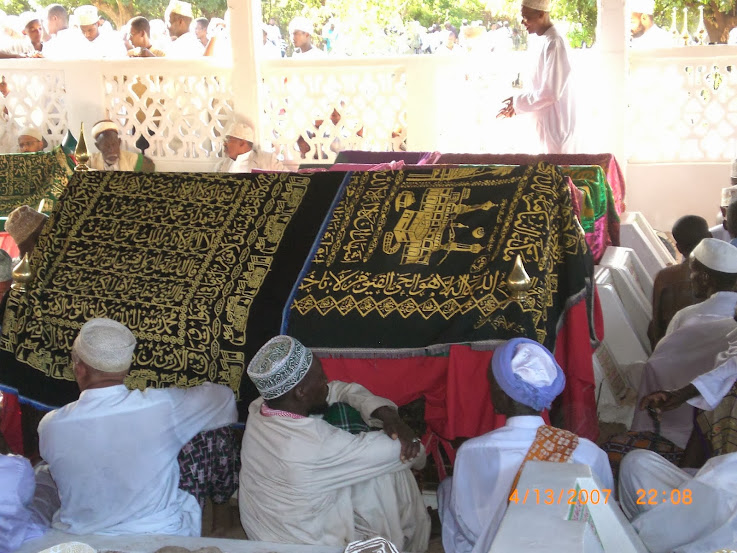
Maulid were as a closing ceremony there is zafa (procession) from Riadha
Mosque to the grave of Habib Saleh called ziara (visit).
The zafa is something to be witnessed as
the whole island turns out for the zafa with various madrasas
reciting kasda while at the same time playing matari. No one but
the sick and the very old remain behind at home. The narrow streets of Lamu are
jammed and fully packed with people. On this day the people of Lamu in their
best attire come out to pay tribute to Maulana Habib Saleh who is revered as a walii
(saint). After the zafa has made its way back to the mosque after maghrib
(evening) prayers, elders dressed in smart kanzus and cap holding
walking sticks known as bakora dance to traditional ngoma outside
the mosque. After isha (night) prayers there is musabak –
competition in recitation of the Qur’an. This marks the end of the Maulid Week
and the following morning soon after fajr prayers people start trekking
back to their homes hoping to come back the following year. As they bid
farewell to each other they say, ‘Insha Allah (God Willing) next year.’
Although Habib Saleh died in 1935 there is no
single photograph of his existing. Many legends are narrated about Habib Saleh
some which are difficult to believe by those not initiated in spiritual matters
as understood by those who were born and raised in Lamu of which Maulana Habib
Saleh is part of its history. But his undisputable legacy and his ever enduring
miracle is the Riadha Mosque and the Lamu Maulid founded by him which are now
part of Lamu’s and indeed Kenya’s history.
Sunday, 15 April 2007




No comments:
Post a Comment